
A Tale of “O” Diversity Training Video
 A number of you asked me for more information about the training video that I mentioned in my Julie/Julia post. Here’s a description:
A Tale of O, the most popular video about diversity worldwide, is unique both in style and content. It shows the striking consequences of being “different” from the others around you – being an O among Xs. The videotape illustrates dramatically how this alone powerfully affects both the Xs treatment of an O and the O’s view of itself, regardless of the nature of the difference. Whether the O differs from the Xs by gender, race, age, language, age or other factors, the effects are similar.
This differential treatment of Os, especially when the difference is highly visible or socially important, is often taken as a sign of bias or deliberate discrimination. A Tale of “O” shows to the contrary that much of this different treatment is largely a consequence of the situation. It is not necessary to blame anyone, unlike many other approaches, which may punish and blame people quite unfairly. A Tale of “O” helps everyone identify with Os since everyone has been an O at one time or another. Moreover, the video suggests whole new avenues to systemic solutions. A Tale of “O” is narrated by its originator, Dr. Rosabeth Moss Kanter of Harvard Business School.
Here’s a link to a vendor that sells the video (in a DVD format). If you sign up for a username and password you can preview the video online in both the 18 and 27 minute format.
I used this video to do training for supervisors on how to integrate women into male-dominated occupations such as law enforcement and cable installation. I prefaced showing it by mentioning that the narrator has a high sing-song voice, which can be distracting. I’d recommend others do that as well if they are showing it in a predominantly male setting.
 Recruiting 101: Have you visited the career links section of
 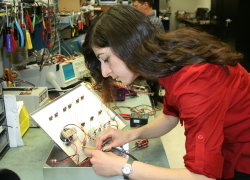 Recruiting 101: The key to recruiting women and girls in a field in which they are under-represented is female role models. You already know their numbers are small, so where do you find these women? IWITTS did a survey in 2005 and found that among educators word of mouth was the leading strategy (86%), followed by connecting with women on the street (66%). Respondents also found doing a newspaper story on their program effective! In addition, I’d recommend putting flyers up in your community saying you are looking for female role models in specific occupations.
 I had the good fortune of seeing the movie Julie and Julia this past weekend and I loved it, as did the rest of the audience! Everyone clapped after many of the scenes—something which rarely happens in the movies. The movie is based on the true stories of the famous, American-French chef Julia Child (played by Meryl Streep) and a New York writer named Julie who decides to cook all of Julia’s recipes in a year and to blog about it daily.
 Have a question on recruiting and retaining women and girls in technology that you want to ask me? Now’s your chance, today I am launching a “Dear Donna” advice column except it will be about gender equity questions. Send your questions to me via
 I am happy to see that U Mass’s Computer Science (CS) Department added photos of women to its homepage. Out of seven photos–two now feature women! Unfortunately, the photos of women don’t show them working in the field with equipment as photos 1, 2 and 4 do for the males. The photos now show a woman writing on a board in a classroom setting and two women in an office setting. One of the recommendations IWITTS makes in our WomenTech training is that photos are taken of women working with equipment. Too often women are portrayed in “passive” roles in the workplace while males are in “active” roles.
 My answer is a resounding yes! It works; research shows that females prefer pink–REALLY. So if you have the opportunity to run flyers in pink or use pink as part of a poster’s color scheme–GO FOR IT. Women and girls identify with the color pink. According to Wikipedia, “The color pink is often used to represent women or young girls.” The Boston Red Sox successfully used the color pink to increase sales of clothing to women coming to their baseball games. Pink baseball hats are the second best-selling color at the souvenir store. The








Recent Comments